The pipeline: text in, tagged errors out¶
This page is the end-to-end contract: what you feed synterr, what comes out, and what every tag on the output means. The four stages are independent CLI commands — you can run just stage 3 or stage 4, but stages 1–2 are how you make sure your corpus can actually feed the error classes you care about.
clean text ──► 1. survey ──► starving classes
                                  │
                  2. mine-pools ◄─┘
                        │
   per-class pools ─────┤
   + base corpus  ──────┴──► 3. generate ────────► tagged training pairs
                        │
                        └────► 4. minimal-pairs ──► labeled contrast pairs (eval)
Stage 0 — prepare input¶
Plain UTF-8 text, one sentence per line (survey additionally skips
lines shorter than five words). The text must be clean (grammatical) —
synterr corrupts it; it does not correct.
Stage 1 — survey: what can this corpus feed?¶
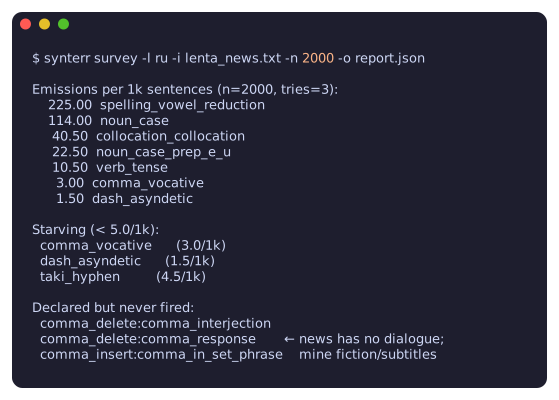
Runs every handler over a sample and reports emissions per 1k sentences for each error subtype, plus two actionable lists:
- starving — subtypes below threshold (default 5/1k); your corpus rarely contains the contexts they need
- never fired — subtypes that found no context at all (on news text these are typically dialogue phenomena: interjections, да/нет responses, vocatives)
Why subtypes starve: precision gates. Handlers refuse to corrupt when
the result wouldn't be a recoverable error — verb_tense needs a
temporal anchor (вчера/завтра), noun_number needs an agreement
witness, dash deletion skips contexts where Rozental permits both
variants. On plain news text verb_tense emits about 25 times per 1k
sentences (survey defaults, 2,000 Lenta sentences). That's correct
behavior; fix the corpus, not the gate.
Stage 2 — mine-pools: feed the starving classes¶
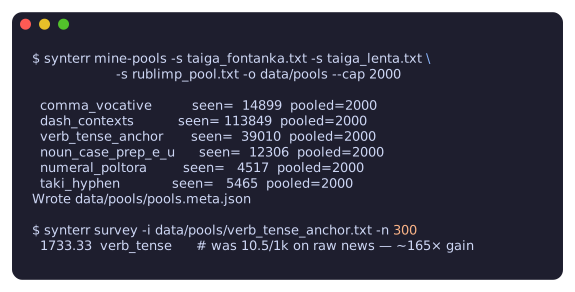
Sweeps large sources with per-class surface patterns and
reservoir-samples up to --cap candidate sentences per class into
data/pools/<class>.txt (+ pools.meta.json with per-run counts and a
classes section carrying per-class provenance — sources, cap, seed —
that survives targeted re-runs over a pattern subset).
Two design points worth knowing:
- Patterns derive from the live handler lexicons (frozen phrases, adverb pair lists, agreement lemma sets, the hyphenated-compound lexicon, …) where possible, so pools cannot drift out of sync with the handlers.
- Pools are recall-oriented. A pool only needs to contain
candidates; the handler's own
can_applydoes the precise filtering at generation time. Measured effect (survey defaults):verb_tenseemits ~25/1k on raw Lenta news vs ~2,300/1k on its mined pool. Same story foragr_sv_collective(§183): it never fired on 2,000 news sentences, but emits ~260/1k on its mined pool — news prose almost never writes «Большинство проголосовало» without a genitive dependent, which is exactly the configuration where only one agreement is normative.
To verify a pool feeds its class, survey it: synterr survey -i
data/pools/<class>.txt.
Stage 3 — generate: tagged training pairs¶
uv run synterr generate -l ru --preset rulec --schema rozental \
    -i mixed_sources.txt -o train.jsonl --output-format jsonl --seed 42
--presetcontrols how often each error type fires (corpus-derived weights:rulec= L2 learner essays,gera= native school texts,lorugec= benchmark-rule uniform,balanced= hand-tuned spread).--schemacontrols what the errors are called (see below).--seedmakes the run reproducible.
Output contract (JSONL)¶
One record per corrupted sentence:
{
  "original":  "Мы гуляли в лесу весь день .",
  "corrupted": "Мы гуляли в лесе весь день .",
  "errors": [
    {
      "type": "noun_case_prep_e_u",
      "category": "MORPH",
      "start_idx": 3, "end_idx": 4,
      "original": "лесу", "corrupted": "лесе",
      "fix_tag": "$REPLACE_лесу",
      "schema_tag": "mo_noun_case",
      "schema_l2_tag": "mo_noun_case_prep_e_u",
      "schema_l2_applicability": "partial"
    }
  ],
  "seed": 42, "schema": "rozental"
}
Field by field:
| field | meaning |
|---|---|
type |
synterr's internal error subtype (handler-level truth) |
category |
detection category: SPELL / MORPH / PUNCT / OTHER |
start_idx, end_idx |
token span of the edit in the corrupted sentence |
fix_tag |
GECToR-style correction tag ($REPLACE_x, $APPEND_x, $DELETE) |
schema_tag |
L1 tag in the chosen schema (e.g. Rozental working tag) |
schema_l2_tag |
fine-grained L2 tag, mapped to specific Rozental §§ |
schema_l2_applicability |
full / partial / none — does the native Rozental rule describe this error as L2 learners make it (see below) |
Who owns which tag (and what happens without --schema)¶
Two layers produce the labels, and they have different lifetimes:
- Handler-owned —
type,category,fix_tag, the span. Always present, schema-independent.typeis the ground truth of what the corruption did (e.g.noun_case_prep_e_u). - Schema-owned —
schema_tag,schema_l2_tag,schema_l2_applicability. These exist only when you pass--schema; there is no default schema ingenerate. Run without it and the JSONL simply has noschema_*fields. The same corpus can be re-labeled under a different taxonomy without regenerating — the mapping lives in the schema YAML, not in the corruption.
Available schemas: rozental (hierarchical, §-grounded), rlc
(Russian Learner Corpus tags), errant. synterr list-schemas is
authoritative.
Related flags elsewhere in the pipeline:
synterr corrupt --schema rlc -e Gov --depparseuses the schema in the other direction — to resolve a schema tag to the handlers that produce it.corruptoutput itself always shows handler-owned labels only.synterr surveyandsynterr mine-poolsare schema-free by design: they report handler subtypes, the stable layer every schema maps onto.
Reading schema_l2_applicability¶
The Rozental schema is a native taxonomy; this field is the bridge to the learner population, rated per fine-grained tag:
- full — the Rozental § directly describes the error both natives and learners make (all spelling and punctuation classes)
- partial — Rozental describes a variant choice; learners produce broader errors in the same territory (e.g. в лесу→в лесе is the native variant slip; a learner more often picks a wrong case entirely)
- none — no bridge: either a native-only phenomenon or a learner-only error Rozental has no § for (word omission/insertion)
A few subtypes (noun_case_subject, verb_tense, conjunction,
comma_subj_pred) carry an L1 tag but no L2 tag — Rozental's
fine-grained level has no slot for them — so they emit no
schema_l2_tag or applicability field. Subtypes with no mapping at all
in the chosen schema (e.g. spelling_keyboard under rozental) emit no
schema_* fields.
Filtering a corpus by population is therefore a one-liner: keep
full for native-style data, full+partial for learner-style data,
and treat none as schema-extension territory.
Stage 4 — minimal-pairs: phenomenon-labeled benchmark pairs¶
uv run synterr minimal-pairs -l ru -i sents.txt -o pairs.jsonl \
    -e pronoun_svoy,neg_genitive --per-error 50
Where generate produces training data (many errors per sentence,
weighted by preset), minimal-pairs produces evaluation data: one
corruption per record — a correct sentence and its single-handler
corruption, held as a contrast pair. Each record carries the
correct/incorrect sentences and spans, the handler, the emitted
error type (contrast, e.g. spelling_keyboard), the schema's L1 tag (phenomenon), the fine-grained
L2 tag (l2), the Rozental §§ it instantiates (paras), and the
l2_applicability field described above.
That labeling supports two different benchmark views over the same emitted file:
- full view — every emitted pair, unfiltered. Tests native-norm grammatical competence: does the model know the rule Rozental states, independent of whether L2 learners actually make that mistake?
- learner view — filter to
l2_applicability == "full". Keeps only the subset where the native prescriptive rule and the learner's actual error coincide, giving a benchmark that's meaningful for evaluating learner-facing correction too.
--schema selects the labeling schema (default: rozental);
--depparse is on by default since several handlers
(agreement, government) require dependency parses to fire correctly.